Long-Distance Fatigue — Planning Rest Stops
Priya drove from Bengaluru to Chennai non-stop — a 340 km journey she had done many times. Two hours in, she turned up the radio. Three hours in, she opened the windows. Four hours in, she stopped noticing. Five kilometres from Chennai, a truck had stopped ahead for a breakdown. She did not see it until 80 metres away. She braked and veered, missing it by a door's width. She had been awake for 19 hours.
The 200 km / 2-Hour Rule
The safest long-distance rest protocol is straightforward: stop and rest every 200 km or every 2 hours, whichever comes first. This applies even when you feel fine. Fatigue accumulates gradually and insidiously — you rarely feel its full effect until you are already dangerously impaired. Build mandatory stops into your journey plan before you leave. On a 600 km drive, plan at least 2 intermediate stops.
increased crash risk after 17 hours of continuous wakefulness
Equivalent to driving at India's legal blood alcohol limit of 0.03%
Source: MoRTH Road Safety Foundation research; Sleep Foundation
Sleep Inertia — The Groggy 15 Minutes
Sleep inertia is the disorientation and reduced performance that occurs immediately after waking. After even a 20-minute nap, you will feel groggy for 10–20 minutes — your reaction time and decision-making are temporarily impaired. Do not drive the moment you wake from a rest stop nap. Get out of the car, walk around, drink water, and give yourself at least 15 minutes to fully rouse before resuming the drive.
Turning up the radio, opening windows, or splashing water on your face are common but ineffective fatigue responses. Studies show they provide at most 5–15 minutes of marginal improvement — insufficient for even a short highway stretch. They also create a false confidence that you have addressed the problem, which is associated with delayed stopping decisions and fatigue-related crashes. Only stopping and sleeping works.
Departing at 5 AM for a 400 km journey means arriving by early afternoon, having driven through the most alert part of the day. Departing at 10 PM for the same journey means driving through the 2–4 AM circadian low — the highest-risk driving window. If a night departure is unavoidable, plan a 30–60 minute sleep stop during the 1–4 AM window and complete the journey after dawn.
At every scheduled stop: park safely at a rest area, dhaba or fuel station, turn off the engine, set a 25-minute alarm and take a nap (approximately 5 minutes to fall asleep + 20 minutes of light restorative sleep). Drink a glass of water after waking. Walk for 5 minutes to overcome sleep inertia. If a co-driver is available, rotate after each 200 km. Eat light — heavy meals significantly increase post-meal drowsiness.
Co-Driver Rotation — The Gold Standard
On journeys over 400 km, a co-driver who can share driving is the safest option. Rotate every 2 hours or 200 km. The resting driver should actually sleep — not navigate, talk, or scroll a phone — as active passenger duties provide no meaningful rest. Brief the co-driver on the route before departure so the driving driver is never distracted mid-journey.
Rest and Service Points on Indian Highways
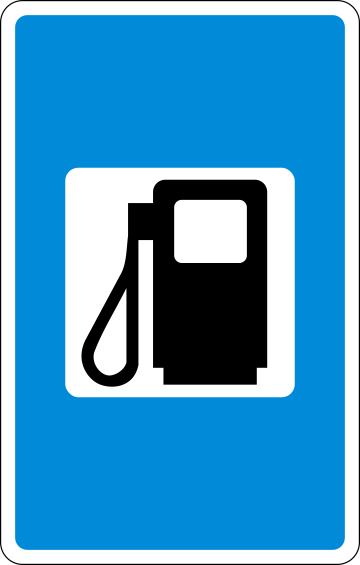
Filling Station
Blue square with fuel pump — refuel while you can on long stretches.

Parking
Blue square with white P — permission granted.
You have been driving for 2 hours and feel 'fine', but notice you recently missed a road sign without registering it. What is the correct action?
Tap an option to reveal the answer
- ✓Stop every 200 km or 2 hours — plan this before departure, not when you feel tired.
- ✓After 17 hours awake, crash risk doubles — equivalent to driving at the legal alcohol limit.
- ✓Sleep inertia: allow 15 minutes after waking before driving — do not rush out of a rest stop.
- ✓Music, cold air and caffeine are delays, not cures — only sleep restores safe driving ability.
- ✓Co-driver rotation every 200 km is the gold standard for journeys over 400 km.
Lawful provides legal information, not legal advice.