Emergency Stop & Breakdown Protocol
Sanjay is driving at 110 km/h on the Delhi–Agra Expressway when his front right tyre blows. The steering wrenches hard right. His first instinct is to jam the brakes — a move that would have sent the car into a spin. Instead, he grips the wheel hard, eases off the accelerator, and steers gently toward the left shoulder. The car slows. He brings it safely to a stop. Sanjay had read about tyre blowout procedure. It saved his life.
Tyre Blowout at Speed — The Correct Response
A tyre blowout at highway speed feels catastrophic. The car violently pulls toward the blown tyre, and every instinct screams 'BRAKE'. Resist completely. Braking hard on a blown tyre at speed causes the remaining tyres to lock unevenly, leading to a spin or rollover. The correct sequence: (1) Grip the steering wheel firmly with both hands. (2) Ease off the accelerator smoothly — do NOT hit the brakes. (3) Steer gently to counteract the pull, keeping the car as straight as possible. (4) Let engine braking reduce speed gradually. (5) Only below 40 km/h, apply brakes gently and steer to the left shoulder.
Braking suddenly during a blowout at speed transfers weight unevenly, lifts load from the blown tyre, and almost certainly triggers a violent spin or rollover. Research indicates that most blowout fatalities involve drivers who braked immediately. Keep the throttle off, hold course, and let the car slow naturally. This feels counterintuitive — but it is the only safe response at speed.
Breakdown on the Highway — Safe Position
If your vehicle breaks down, or after safely stopping from a blowout: move as far left onto the hard shoulder as possible — ideally off the carriageway entirely. Activate hazard lights immediately. All occupants must exit the vehicle on the LEFT side (away from traffic) and stand behind the crash barrier if one exists, or at least 30 metres ahead of the vehicle — NOT between the vehicle and oncoming traffic. The vehicle itself acts as a barrier for occupants standing ahead of it near the barrier.
Every car should carry a reflective warning triangle (it is a legal requirement in CMVR). After breaking down, place the triangle at least 50 metres behind your vehicle on the hard shoulder side. At night, 100 metres is safer. This gives approaching drivers advance warning at highway speeds. Walk along the hard shoulder to place it — never stand in the traffic lane. Use a torch to illuminate the triangle at night.
(1) Steer to the hard shoulder; stop as far left as possible. (2) Activate hazard lights. (3) All occupants exit left-side doors and move behind the crash barrier. (4) Walk 50 metres back along the shoulder and place the warning triangle. (5) Call NHAI 1033 (National Highway), police 112, or ambulance 108 if injured. (6) Wait behind the barrier — do not work under the car on the carriageway. (7) Keep children and elderly away from the road edge.
NHAI 24/7 emergency helpline for National Highway breakdowns
Police: 112 | Ambulance: 108 | Highway patrol: state-specific numbers
Source: National Highways Authority of India
Never Stand Behind Your Vehicle on the Highway
A stationary vehicle on or near the carriageway is at extreme risk of being rear-ended, especially at night or in poor visibility. Standing behind your vehicle — even with hazard lights on — puts you in the most dangerous possible position. Rear-end collisions into broken-down vehicles are common on Indian highways, particularly at night. Always move ahead of your vehicle or behind the crash barrier.
Carry an Emergency Kit
Every vehicle should carry: a reflective warning triangle, a reflective safety vest (wear it before exiting the car on a highway), a torch with charged batteries, a first aid kit (legal requirement under CMVR for commercial vehicles; strongly advised for all), a fire extinguisher (legally required for commercial vehicles), and the NHAI number saved in your phone. These items cost little and can be the difference between a manageable incident and a fatality.
Signs at Highway Works and Hazard Zones
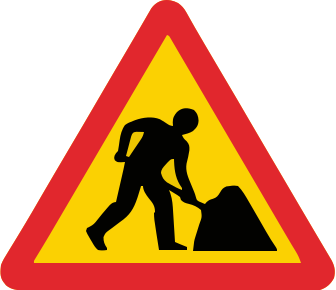
Road Works Ahead
Triangle with figure digging — someone is building the road you drive on.
A tyre blows out at 100 km/h on the expressway. What is the first action to take?
Tap an option to reveal the answer
- ✓Tyre blowout: grip firmly, ease off throttle, no sudden braking — let speed reduce naturally before gentle braking.
- ✓Breakdown: hard shoulder as far left as possible, hazard lights on, exit the vehicle on the LEFT side.
- ✓Warning triangle: at least 50 metres behind the vehicle (100m at night), placed along the shoulder.
- ✓Stand ahead of the vehicle or behind the crash barrier — never between your car and oncoming traffic.
- ✓NHAI emergency helpline: 1033. Police: 112. Ambulance: 108.
Previous
Multi-Lane Discipline — The Slow Lane Is Not Optional
Next
Long-Distance Fatigue — Planning Rest Stops
Lawful provides legal information, not legal advice.