Night Fatigue — When Your Body Says Stop
Dilip left Pune at 11 PM for Hyderabad — 560 km. By 2:30 AM he had crossed Solapur and felt oddly calm and focused. Then, without warning, he woke to the sound of rumble strips. His car had drifted to the shoulder. He had been asleep for approximately 4 seconds — enough to travel over 110 metres at 100 km/h, completely unguided.
Your Circadian Rhythm — Biology Is Not Negotiable
The human body has a built-in biological clock (circadian rhythm) that creates two peaks of sleepiness every 24 hours: a major trough between 2 AM and 4 AM, and a minor one between 1 PM and 3 PM. During the 2–4 AM window, your body's drive to sleep is at its absolute strongest — regardless of how much coffee you have consumed or how alert you feel. Reaction time, decision-making and hazard perception all degrade significantly in this window. This is the most dangerous driving period of the day.
of highway fatalities in India are linked to driver fatigue
Fatigue impairs driving as severely as a blood alcohol level of 0.08%
Source: MoRTH Road Accidents in India Report 2022
Microsleep — The Silent Killer
Microsleep is an involuntary sleep episode lasting 3–15 seconds. The driver typically has no awareness it happened. At 100 km/h, a 4-second microsleep means your car has travelled 111 metres completely unguided. Studies show that microsleep often occurs when the driver feels 'comfortably tired' — the dangerous stage where they believe they can manage. Warning: you cannot feel yourself falling asleep. Your first warning may be waking on the rumble strip or in the ditch.
Warning Signs — Recognise Them Early
Early fatigue warnings include: frequent yawning, heavy eyelids, difficulty keeping eyes focused, slower reaction to hazards, inconsistent speed maintenance, drifting within the lane, missing road signs or junctions, and finding yourself unable to recall the last few kilometres. If you experience any two of these simultaneously, you are already significantly impaired. Pull over immediately — do not negotiate with yourself about how far you still have to go.
Caffeine masks the subjective feeling of sleepiness for 30–60 minutes but does not restore reaction time, hazard perception or decision-making to alert levels. The 'coffee works' sensation is caffeine delaying your sense of tiredness — not fixing your impaired driving. After the caffeine window, fatigue hits harder. Stopping and sleeping is the only real cure.
If possible, depart long-distance drives early in the morning (4–6 AM) to arrive before midnight. If you must drive through the 2–4 AM window, plan a mandatory 30-minute stop at a highway rest area or dhaba. Avoid departing at 10–11 PM, which guarantees you will be driving in your deepest circadian low. A co-driver who can take over is the safest option on very long trips.
Stop every 2 hours or 200 km, whichever comes first. A 20-minute nap is significantly more restorative than 20 minutes of stretching or caffeine. Keep windows cool — warm cabin air accelerates drowsiness. Avoid heavy meals before or during long night drives. At highway rest stops, take a 5-minute walk before resuming. Do not attempt to drive the 'last stretch' past your safe limit.
Helpful Signs on Long Night Drives
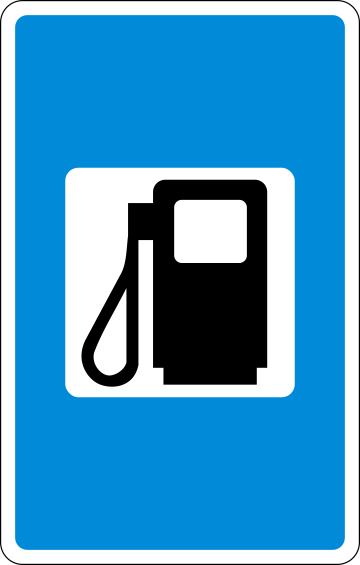
Filling Station
Blue square with fuel pump — refuel while you can on long stretches.
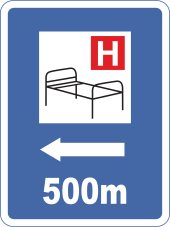
Hospital
Blue square with H — H for Hospital, always hushed.
At 100 km/h, how far does your car travel during a 4-second microsleep?
Tap an option to reveal the answer
- ✓The 2–4 AM window is the most dangerous driving time — your circadian low makes microsleep almost inevitable without rest.
- ✓Microsleep lasts 3–15 seconds and you will not feel it happening — your first warning may be the crash.
- ✓Coffee buys 30–60 minutes at most — only sleep restores safe driving ability.
- ✓Stop every 2 hours or 200 km; a 20-minute nap is more effective than any stimulant.
- ✓Plan long drives to avoid the 2–4 AM window; if unavoidable, stop and sleep through it.
Lawful provides legal information, not legal advice.