Aquaplaning & Wet Braking — Physics in the Rain
You are cruising at 95 km/h on NH48 when the monsoon suddenly intensifies. Without warning your steering goes feather-light — and the car begins drifting left despite you holding the wheel straight. You instinctively stamp the brakes. The car lurches sideways. This is aquaplaning, and braking just made it significantly worse.
What Is Aquaplaning?
Aquaplaning (also called hydroplaning) occurs when your tyre encounters more water than it can disperse through its tread channels. Instead of gripping the road surface, the tyre rides up on a thin film of water. At this moment your tyres have essentially zero traction — steering inputs have little effect and braking either does nothing or causes a skid. The car goes where physics sends it, not where you steer.
When Does Aquaplaning Start?
Aquaplaning typically begins at speeds of 80–100 km/h in heavy rain, though it can occur at lower speeds with badly worn tyres. Three key factors determine risk: (1) vehicle speed — higher speed gives the tyre less time to displace water; (2) tyre tread depth — channels must carry water away from the contact patch; (3) water depth on the road — deeper puddles increase risk dramatically. The legal minimum tread depth in India is 1.6mm, but tyres at that level already have significantly reduced wet-weather grip.
increase in stopping distance on wet roads
Can double in heavy rain or on standing water
Source: MoRTH Road Safety Report 2022
What To Do If Aquaplaning Occurs
The correct response: (1) Ease off the accelerator smoothly — do not snap the throttle closed. (2) Do NOT brake suddenly — braking on an aquaplaning tyre will cause a violent skid. (3) Do NOT make sudden steering inputs — hold the wheel firmly and steer gently in the direction you want to go. (4) Wait for the tyres to regain contact with the road as speed drops — you will feel the steering become heavy again. Only brake gently once grip is restored.
Stamping the brakes when your tyres are riding on a water film causes an immediate loss of directional control — locked wheels skid unpredictably across the surface. Even with ABS, braking during aquaplaning is dangerous because ABS is designed to manage tyre–road friction, not tyre–water interaction. Ease off the throttle and wait for grip to return.
The ABS Misconception
Many drivers believe ABS (Anti-lock Braking System) reduces stopping distances on wet roads. It does not. ABS prevents wheel lockup, which maintains steering control during hard braking — a vital safety benefit. But on wet roads, stopping distances are 30–50% longer than on dry, and ABS cannot change that physics. On surfaces with standing water, ABS's benefit is maintaining steerability, not shorter stops. Slow down regardless of whether your vehicle has ABS.
Tyres with tread depth below 3mm (the safe wet-driving threshold, above the 1.6mm legal minimum) dramatically increase aquaplaning risk. Before monsoon season: check tread depth with a coin or gauge, inspect sidewalls for cracks, confirm correct tyre pressure (under-inflation worsens aquaplaning). Replace tyres showing centre wear, edge wear, or cupping patterns.
Slow to 60–70 km/h in heavy rain from a typical highway cruise of 80–100 km/h. Increase following distance to at least 4 seconds — double the normal 2-second rule. Avoid deep puddles and water channels at the road edge. Brake before corners, not during. Keep tyre tread above 3mm. If you feel the steering go light, ease off throttle gently and hold course.
Signs to Watch in Wet Conditions
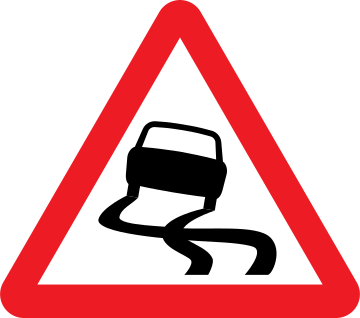
Slippery Road
Triangle with car and wavy lines — the car is literally sliding on the sign.
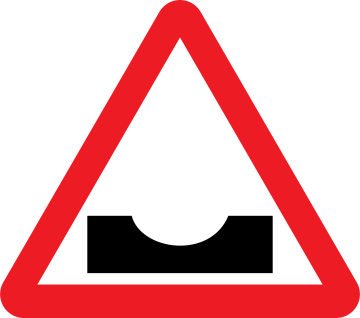
Dip Ahead
Triangle with a valley shape — opposite of the hump.
Your car starts aquaplaning at highway speed. What is the correct immediate action?
Tap an option to reveal the answer
- ✓Aquaplaning starts at ~80–100 km/h in heavy rain when tyres ride on a water film with zero traction.
- ✓If aquaplaning: ease off throttle smoothly — do NOT brake suddenly or steer sharply.
- ✓Wet stopping distances are 30–50% longer than dry — increase your following distance in rain.
- ✓ABS prevents wheel lockup but does NOT reduce wet stopping distance — slow down regardless.
- ✓Check tyre tread depth before every monsoon season — keep above 3mm for safe wet-weather grip.
Previous
Headlight Etiquette — High Beam vs Low Beam
Next
Visibility — Wipers, Fog Lights & Speed in Rain
Lawful provides legal information, not legal advice.