After the Accident — Police, FIR & Insurance Claims
Meera's car was rear-ended at a signal. The other driver sped off. She called 100, and the police came — but told her she must go to the police station in the area where the accident happened, not the one near her home. Her insurance company asked for an FIR before processing anything. She spent three days running between offices before anyone told her: she had the right to file the FIR anywhere from day one. Knowing this would have saved her 72 hours.
FIR — First Information Report
An FIR (First Information Report) is the formal document that starts a criminal investigation. In road accident cases, it records: the facts of the incident, parties involved, injuries, and witnesses. The Supreme Court has held that police must register an FIR at any police station, regardless of territorial jurisdiction — the station that receives the complaint is obligated to register it and then transfer the investigation to the appropriate jurisdiction if needed. You cannot be turned away with 'this isn't our area.' Get the FIR number — every subsequent step (insurance, court) depends on it.
Under the Supreme Court's ruling in Lallan Chaudhary vs State of Bihar (2006) and reiterated in subsequent judgments, territorial jurisdiction is not a ground to refuse FIR registration. Walk into the nearest police station. If they refuse, escalate to the Superintendent of Police (SP) or file a complaint under s.154(3) CrPC (now BNSS s.173) directly with the SP. You can also file an e-FIR through the state police portal in many states.
Motor Accident Claims Tribunal (MACT) — Not Civil Court
Compensation claims for road accident injuries and deaths go to the Motor Accident Claims Tribunal (MACT), not to a civil court. MACT is a specialised quasi-judicial body established under Chapter XI of the Motor Vehicles Act 1988. It handles claims faster than civil courts, with simpler procedures. Third-party insurance (mandatory under MVA s.146) covers liability to others — if a third party is injured and the responsible driver is insured, their insurer must compensate. Own-damage insurance is separate and optional.
Every vehicle on Indian roads must carry at minimum a valid third-party insurance policy (MV Act s.146). If you are injured by another vehicle and that driver has insurance, you can claim compensation through MACT against their insurer. Even if the driver is untraceable or uninsured, the Solatium Fund (maintained by insurers under MV Act s.163) provides limited no-fault compensation. You do not need to prove fault to access the Solatium Fund.
How to Dispute an e-Challan
If you receive an e-challan you believe is incorrect — wrong vehicle, faulty camera, you were not the driver — you can dispute it online at parivahan.gov.in or through the Umang app. Select 'Challan Services' → 'Check Challan Status' → submit a dispute with supporting evidence (photos, alibi, parking receipt). If the dispute is rejected, you may appear before the relevant JMFC (Judicial Magistrate of First Class) court on the challan date and present your case in person.
The Right to Information Act 2005 applies to all public authorities including police stations. If police are refusing to give you the FIR copy, delaying action, or withholding investigation updates, file an RTI application at the police station. Attach a ₹10 postal order (the fee), address it to the Public Information Officer (PIO) of the relevant police station, and state exactly what documents or information you want. A response is legally required within 30 days.
Know Where to Go After an Accident
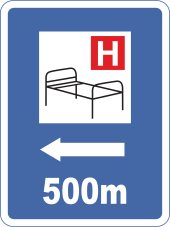
Hospital
Blue square with H — H for Hospital, always hushed.
Suresh was injured when a car ran a red light. He wants to claim compensation. Where does his claim go?
Tap an option to reveal the answer
- ✓Any police station must register your FIR — territorial jurisdiction cannot be used to turn you away.
- ✓Always obtain the FIR number — it is required for insurance claims, MACT petitions, and legal proceedings.
- ✓Compensation claims for accident injuries go to MACT, not civil courts — the process is faster and simpler.
- ✓Third-party insurance is mandatory; the Solatium Fund provides no-fault compensation even if the other driver is uninsured.
- ✓RTI Act 2005 is your tool if police delay or withhold your FIR — a response is legally required within 30 days.
Lawful provides legal information, not legal advice.