First Response — Secure, Signal, Support
You round a bend on a state highway and your headlights catch it — a truck has clipped a car and both have spun onto the road. There are three cars behind you. Your heart pounds. You know the Good Samaritan law protects you. But what exactly do you do in the next 60 seconds? The answer isn't instinct — it's a three-step protocol that saves lives and prevents secondary crashes.
The Golden Hour — the window where trauma survival rates are highest
Every minute of delay before professional care reduces survival probability. Your first call to 108 starts the clock in the right direction.
Source: WHO Road Safety Report 2023
The Three-Step Protocol: Secure → Signal → Support
Emergency responders worldwide use variations of this sequence because it protects three groups in order of priority: (1) you, (2) other road users approaching the scene, (3) the victim. Helping a victim while becoming a victim yourself doubles the casualty count. The sequence is not optional — skipping SECURE or SIGNAL to rush straight to SUPPORT causes secondary crashes that kill rescuers and add more victims.
Before you exit your vehicle: turn on your hazard lights immediately. Pull your vehicle well off the road — on the shoulder or verge, not partially blocking a lane. Switch off the engine. Only then exit, and stay clear of moving traffic. A stopped or slow-moving person on a dark highway is nearly invisible to approaching drivers. Your life is worth protecting too.
Place your warning triangle at least 50 metres behind the accident scene — further on a high-speed road or after a blind bend. If you have a second person with you, station them to wave down approaching vehicles. Your hazard lights alone are insufficient warning at highway speeds. At night, use a torch if available. The goal: give approaching drivers at least 4-5 seconds of warning time before they reach the scene.
Call 108 (National Ambulance Service) and simultaneously dial 112 (Police) if injuries are visible. Stay with the victim until the ambulance arrives. Do not move the victim unless there is immediate fire, flood, or live-wire danger. Talk to them — a conscious victim needs reassurance. Keep them warm with a jacket or blanket if available. Note: 1033 is the NHAI highway helpline — useful for highway incidents where police or NHAI patrol response may be faster.
What to Tell the 108 Operator
Operators are trained to handle panicked callers. Give them: (1) Your location — use a GPS Plus Code from Google Maps (share screen if possible), or a highway milestone number (e.g., 'NH-44, milestone 312'), or nearest town and direction. (2) Number of victims — approximate is fine ('about 3 people'). (3) Visible injuries — 'one person is unconscious', 'bleeding from head', 'trapped under vehicle'. (4) Your phone number in case the call drops. The operator will guide you through the rest. Do not hang up until they do.
Emergency Numbers to Save Now
112 — National Emergency Number (Police, routes to nearest station). 108 — National Ambulance Service (medical emergency, free of charge). 1033 — NHAI Highway Helpline (accidents on national highways, also dispatches patrol vehicles). Save all three in your phone contacts labelled clearly. On many smartphones, 112 can be dialled even without a SIM or when the screen is locked — this is a legally mandated feature.
Unless there is immediate danger (active fire, rising water, downed live electrical wire), do not move an injured person. Moving someone with an undetected spinal injury can convert a partial injury into complete paralysis. This is covered in detail in the next lesson — but remember it as an absolute default: your hands off the victim's body unless danger is imminent.
Locate Help Quickly Using These Signs
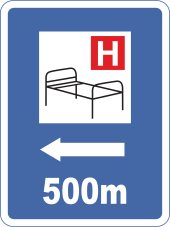
Hospital
Blue square with H — H for Hospital, always hushed.
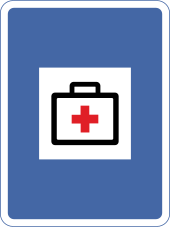
First Aid Post
Blue square with red cross — the red cross never changes meaning.
You arrive at an accident scene on a national highway at night. What is the correct FIRST action before approaching the victim?
Tap an option to reveal the answer
- ✓Always follow Secure → Signal → Support in sequence. Skipping steps creates secondary crashes.
- ✓Pull your vehicle completely off the road and activate hazard lights before exiting.
- ✓Place warning triangle at least 50 metres behind the scene — further on high-speed roads.
- ✓Call 108 (ambulance) and 112 (police). Give location, victim count, and visible injuries.
- ✓Stay with the victim, keep them warm and conscious, but do not move them unless danger is immediate.
Previous
Good Samaritan Law — You Are Legally Protected to Help
Next
Do Not Move the Injured — Spinal Injury Risk
Lawful provides legal information, not legal advice.