Good Samaritan Law — You Are Legally Protected to Help
It's 9 PM on NH-44. Your headlights sweep across a motorbike lying across the road, its rider motionless on the tarmac. Your first instinct is to stop — but a voice in your head whispers: 'What if police blame me? What if I'm dragged to court for years?' You slow down… and drive past. The next morning, you read he didn't make it. That voice was wrong. The law protects you. It always did.
of road accident victims die waiting for help
Most within the first 30 minutes — the Golden Hour. Bystander action could save them.
Source: MoRTH 2022
The Law That Protects You: MV Amendment Act 2019, Section 134A
India enacted the Good Samaritan Law through the Motor Vehicles (Amendment) Act 2019, Section 134A, building on Supreme Court guidelines issued in the Savelife Foundation case (2016). This law creates a legal shield for any person who, in good faith, provides emergency assistance to a road accident victim. You are not required to be a doctor, a trained first-aider, or even know the victim. The only condition is 'good faith' — meaning you genuinely intend to help, not harm.
A Good Samaritan who takes an accident victim to a hospital or calls for help cannot be detained at the hospital or at a police station. You may drop the victim and leave. The hospital must admit the victim immediately — they cannot delay care to collect paperwork or insist you stay.
No police officer, hospital staff member, or any authority can compel you to reveal your name, address, or any personal information. Sharing your identity is entirely your choice. If you wish to remain anonymous, that is your legal right under s.134A.
If you choose to give a statement to police, you give it once — voluntarily. You cannot be called back repeatedly, summoned to testify multiple times, or treated as a witness in ongoing legal proceedings simply because you helped. That single statement is the end of your legal obligation.
If the victim's condition worsens or they pass away despite your good-faith effort to help, you bear zero legal liability — civil or criminal. You cannot be sued for compensation. You cannot be charged with negligence. The law draws a clear line: intent to help, in good faith, is fully protected.
Why People Still Don't Stop — And Why That Fear Is Outdated
A 2018 survey by Savelife Foundation found that 88% of Indians had witnessed a road accident but 74% did not help — primarily due to fear of police harassment, being named as a witness, or hospital formalities. These fears were valid before 2016. They are not valid today. The Savelife Foundation petition to the Supreme Court, and the subsequent 2019 amendment, were specifically designed to dismantle every one of these barriers. When you drive past, you are acting on a fear the law removed years ago.
How to Help — The Four Steps
Step 1: Call 108 (ambulance) and describe the location clearly. Step 2: If safe to do so, stay with the victim — talk to them, keep them conscious and warm, but do not move them unless there is fire or flood risk. Step 3: If you choose to transport them, take them to the nearest hospital (not necessarily a government one — private hospitals must admit accident victims under MV Act). Step 4: Give one voluntary statement to police if asked, then you are free to go. That's it.
Signs That Help You Locate Help
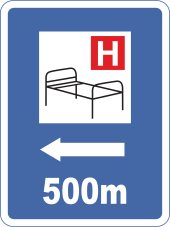
Hospital
Blue square with H — H for Hospital, always hushed.

First Aid Post
Blue square with red cross — the red cross never changes meaning.
Rajan stops to help an accident victim and drives the victim to the nearest hospital. The police arrive and ask Rajan to stay and give a detailed statement. Rajan is worried he'll be called to court repeatedly. What does the Good Samaritan Law say?
Tap an option to reveal the answer
- ✓Good Samaritan Law (MV Amendment 2019, s.134A) gives you full legal protection when you help in good faith.
- ✓You cannot be detained at a hospital or police station — drop the victim and leave if needed.
- ✓Revealing your identity is voluntary. You can remain completely anonymous.
- ✓One voluntary police statement is all that is required — you will never be called as a repeat witness.
- ✓Civil and criminal immunity is absolute if you acted in good faith. Fear of legal trouble is no longer a valid reason not to stop.
Lawful provides legal information, not legal advice.