Blind Spots — Yours and Every Vehicle Around You
You check your mirror, indicate, and begin to change lanes. Suddenly a motorcycle appears from nowhere alongside you. You swerve back just in time. The motorcycle was there the whole time — in your blind spot. Every driver has them. Knowing where they are can save a life.
Your Car's Blind Spots
Even with well-adjusted mirrors, a car has two primary blind spots: the rear-left quarter (between your left mirror and direct rear view) and the rear-right quarter (between your right mirror and direct rear view). A vehicle in your blind spot can travel alongside you completely invisible in your mirrors. The only way to detect it is a physical 'head check' — turning your head briefly to look over your shoulder before any lane change.
Trucks Have Four Blind Spots — Much Larger Than Yours
A truck has four blind zones: directly in front (up to 10 metres — the driver cannot see you), directly behind (up to 30 metres — tail-swing and mirror limits), and along both sides (approximately 3 metres wide on each side). The right-side blind spot extends from the cab to beyond the trailer. The simple rule: if you cannot see the truck driver's face in their side mirrors, the truck driver cannot see you.
Travelling alongside a truck in its side blind zone is extremely dangerous. The driver may change lanes without seeing you, or the truck may drift. When overtaking a truck, do it swiftly — spend as little time as possible alongside the trailer. If you are overtaking and realise you cannot complete the pass, drop back immediately into a safe following position rather than sitting alongside the truck indefinitely.
The correct procedure before every lane change: (1) Check the rear-view mirror. (2) Check the mirror on the side you're moving toward. (3) Signal your intention. (4) Turn your head briefly to check the blind spot over your shoulder. (5) Move smoothly only if clear. This head check takes less than one second and is the only reliable way to detect a vehicle in your blind spot. Mirrors alone are not enough.
Buses Cannot See You Either — The Mirror Rule
Bus drivers sit high and have large wing mirrors, but the geometry of a bus creates substantial blind zones along both sides. Motorcycles and small cars travelling alongside a bus are often invisible to the driver. Never ride or drive directly alongside a bus for extended periods. If a bus begins to move toward your lane, back off — do not try to hold your position. The bus driver almost certainly does not know you are there.
Relevant Signs

Keep Left
Blue circle with white arrow pointing left — blue means positive instruction, not prohibition.
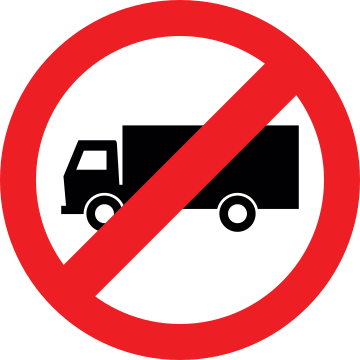
Trucks Prohibited
Truck silhouette in a crossed red circle — big vehicles, no entry.
You are about to change to the right lane on a highway. You check your rear-view mirror and right side mirror — both appear clear. What must you do before moving?
Tap an option to reveal the answer
- ✓Your car has rear-left and rear-right blind spots that mirrors cannot show — always head-check before lane changes.
- ✓Trucks have four blind zones: 10m front, 30m rear, 3m on each side.
- ✓If you can't see the truck driver's face in their mirror, they can't see you.
- ✓Never linger alongside a truck or bus — pass swiftly or drop back.
- ✓Lane change procedure: mirror → mirror → signal → head check → move.
Lawful provides legal information, not legal advice.