Hazard Perception — Reading the Road Ahead
A school van has stopped ahead and children are spilling onto both sides of the road. An autorickshaw cuts right in front of you to reach a fare. A pothole opens up 10 metres ahead. All three happen within 5 seconds. The drivers who survive these situations are the ones who saw them coming before they became emergencies.
Scan 12 Seconds Ahead at Highway Speeds
At 80 km/h you cover approximately 220 metres in 10 seconds. Expert drivers scan the road 12 seconds ahead — roughly the distance that gives them time to identify, decide, and respond to hazards before they become emergencies. In city traffic where 12 seconds corresponds to a much shorter physical distance, scan to the furthest visible point and process hazards as you approach. Fixating on the vehicle directly ahead (target fixation) is one of the most common driving errors.
The SIPDE Method
SIPDE stands for Scan, Identify, Predict, Decide, Execute. Scan the entire road environment continuously — not just the car ahead, but footpaths, intersections, side streets, and the behaviour of vehicles three or four cars ahead. Identify potential hazards and classify them. Predict what they might do — a child running on the footpath may step out. Decide on your response — slow down, move position, prepare to stop. Execute that decision smoothly before the hazard becomes critical.
Certain situations demand heightened alertness on Indian roads: school zones at arrival/departure times (children unpredictable), autorickshaws stopping suddenly without signalling, cattle on rural roads especially at dawn and dusk, buses pulling out from stops, vehicles reversing out of driveways with no warning, and pot-holes that force sudden swerves by the vehicle ahead. Anticipate these rather than react to them.
Defensive driving means positioning your vehicle to maximise your options. Avoid driving alongside other vehicles in adjacent lanes for extended periods — this eliminates your escape path sideways. Keep at least 1 metre clearance from the road edge and from parked cars (doors may open). Position yourself where you can see and be seen, and where you have the most space to manoeuvre if needed.
Mirror Scanning — Every 5–8 Seconds
Your rear-view and side mirrors tell you what is happening behind and beside you — information critical for any lane change, speed reduction, or emergency braking decision. Scan your mirrors every 5–8 seconds in normal driving and more frequently in heavy traffic. Before every braking event, a quick mirror check tells you if the car behind is too close — if so, apply brakes more gradually to give them warning. On a motorcycle this becomes even more critical as you are more vulnerable.
Hazard Warning Signs to Watch For
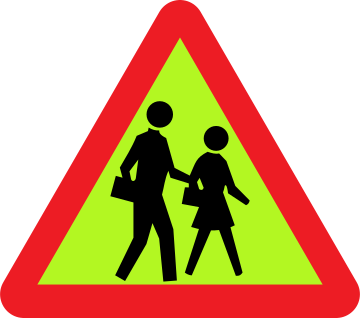
School Ahead
Triangle with children figures — small unpredictable humans ahead.
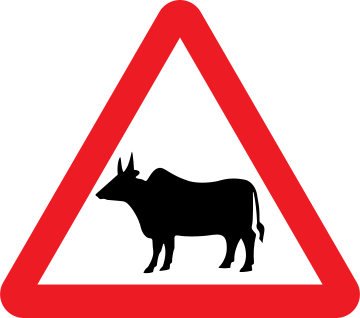
Cattle / Animals on Road
Triangle with cow figure — the animal has not read the highway code.
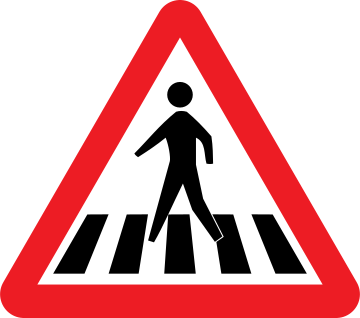
Pedestrian Crossing Ahead
Triangle with walking figure — someone is about to cross your path.
Using the SIPDE method, you notice children playing near the roadside 200 metres ahead. What is the correct next step after Identifying this?
Tap an option to reveal the answer
- ✓Scan 12 seconds ahead at highway speeds — cover the entire road environment, not just the car in front.
- ✓Use SIPDE: Scan → Identify → Predict → Decide → Execute in every hazard situation.
- ✓High-risk zones: school areas, autorickshaw stops, cattle, bus stops, and vehicles reversing.
- ✓Check mirrors every 5–8 seconds — before braking, know if the driver behind is too close.
- ✓Maintain a buffer zone on both sides — keep escape options open at all times.
Previous
The 3-Second Rule & Safe Following Distance
Next
Blind Spots — Yours and Every Vehicle Around You
Lawful provides legal information, not legal advice.